
Join Our Certified Sound Behaviorist Course
Advance Your Career

Becoming a Certified Sound Behaviorist™ establishes you as a trained professional in the science of animal hearing, acoustic assessment, and species-specific sound support. This certification provides the knowledge and practical skills to evaluate hearing health, identify sound-related stress indicators, and implement structured sound protocols that support emotional regulation, comfort, and behavioral balance in animals.
Through this training, you gain the ability to integrate hearing awareness into your professional services, conduct structured sound observations, and apply research-informed sound therapy within your scope of practice. Certification reflects a higher level of expertise, positioning you to offer sound-informed care that enhances animal welfare and distinguishes your professional role in veterinary, training, grooming, shelter, and animal-care environments.
“The hearing screening awareness component alone is worth the course. It gave our team a standardized way to observe auditory responsiveness without crossing diagnostic lines. We’ve already implemented environmental adjustments in our treatment area based on what we learned.”
Dr. Aaron L., DVM, Medical Director

Certified Sound Behaviorist™ Course Modules
Module 1: Foundations of Animal Hearing Science
Understand how dogs and cats hear, including frequency sensitivity, auditory processing, and how hearing differences influence behavior and emotional state.
Module 2: Sound and the Nervous System
Learn how sound affects the autonomic nervous system and influences stress, regulation, and emotional balance.
Module 3: Identifying Sound-Related Stress Indicators
Recognize behavioral signs of sound sensitivity and acoustic stress using structured observation methods.
Module 4: Hearing Screening and Structured Sound Assessment
Learn how to use the Pet Acoustics hearing screening tool and assessment framework to evaluate hearing awareness and acoustic responsiveness.
Module 5: Acoustic Environment Evaluation and Sound Protocols
Evaluate environmental sound exposure and implement species-specific sound protocols to support calm and comfort.
Module 6: Professional Integration and Ethical Application
Learn how to integrate sound assessment and sound support into your professional services using proper documentation and ethical standards.
“The behavioral timeline assignment helped me understand recovery time as a welfare indicator. I now observe not just how animals react to sound, but how long it takes them to return to baseline. That insight alone has improved patient handling.”
Stephanie R., RVT Integrative Practice
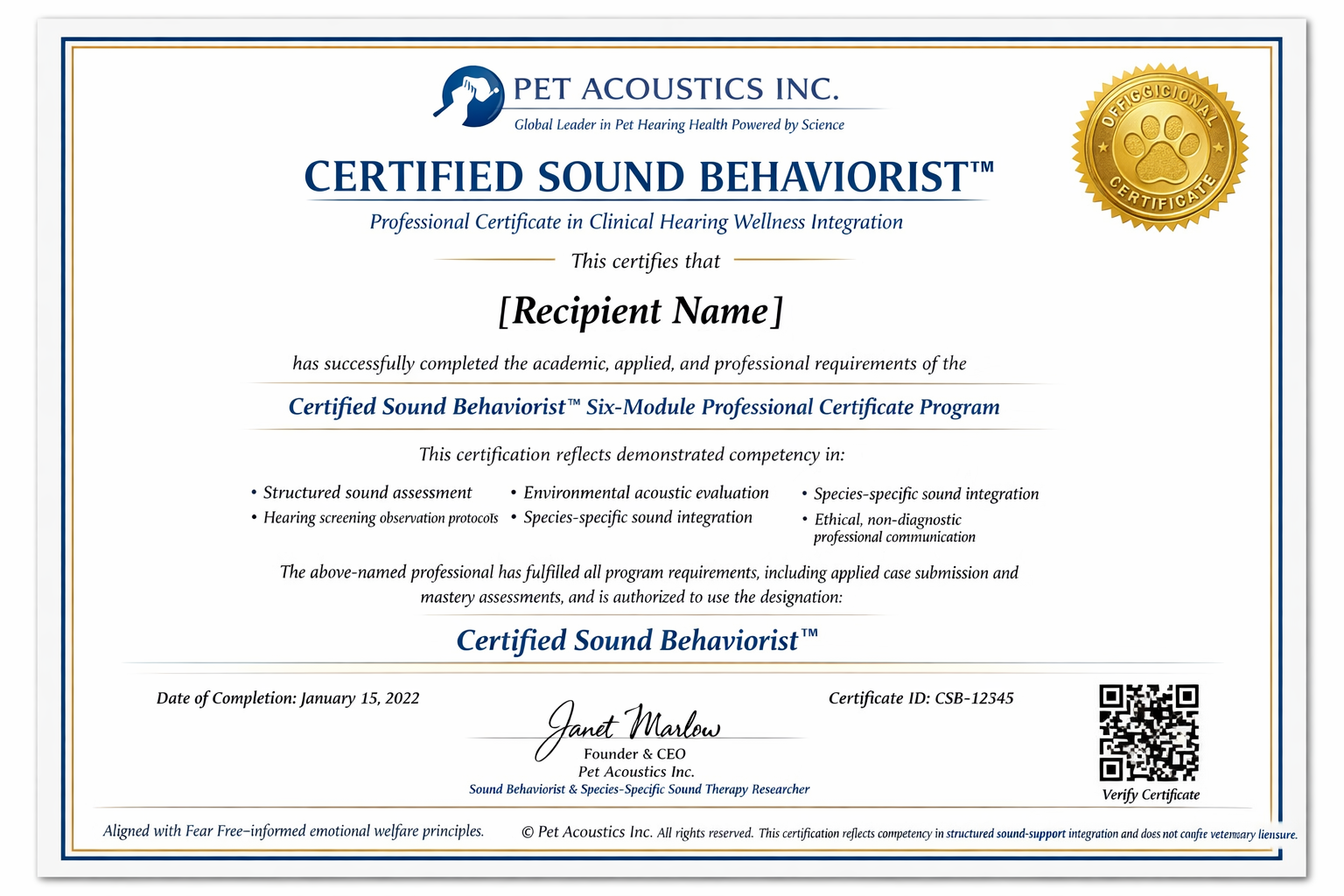
Professional Benefits of Certified Sound Behaviorist™ Certification
• Conduct structured hearing awareness screenings using the Pet Acoustics hearing assessment framework
• Identify and document sound-related stress indicators and acoustic sensitivities
• Evaluate the animal’s acoustic environment, including noise exposure and stress-contributing sound sources
• Implement species-specific sound support protocols to promote calm, regulation, and emotional comfort
• Provide sound-informed environmental recommendations for homes, clinics, grooming, and care settings
• Integrate hearing awareness and sound support into existing professional services within scope of practice
• Maintain professional documentation of sound observations and sound protocol implementation
• Communicate sound-related observations appropriately with veterinary and animal-care teams
• Offer structured sound assessments and sound support services as a billable professional service where permitted
• Differentiate your professional expertise with an advanced certification in animal hearing and sound-informed care
“The acoustic environment audit worksheet was eye-opening. We identified echo patterns and kennel noise layering that we had never considered. After making small changes, we saw faster settling times in several dogs.”
James T., Boarding Facility Manager