
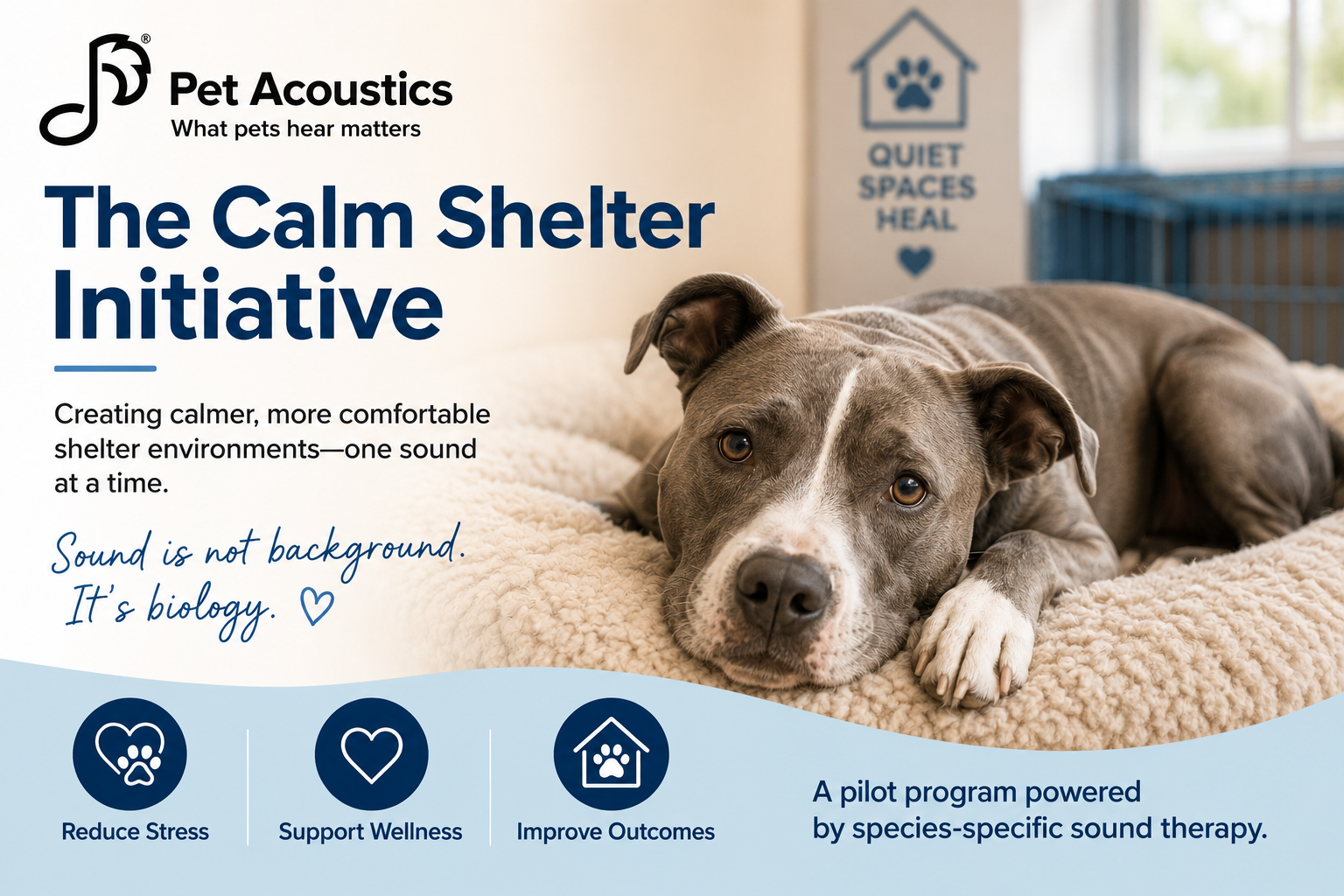
The Calm Shelter Initiative
Every animal deserves the chance to show who they really are.
Every day, thousands of shelter animals arrive frightened, overstimulated, and uncertain. Hard kennel surfaces, constant barking, unfamiliar smells, and continuous activity create an environment that can make it difficult for animals to relax and present their true personalities.
This pilot explores one simple question: can a carefully designed acoustic environment help create a calmer experience for animals — and the people who care for them?
Shelter noise is one of the most overlooked welfare challenges.
A cycle of stress
Constant barking creates a continuous loop of arousal that's hard to break.
Animals and caregivers
Elevated arousal affects not only the animals, but the staff and volunteers around them.
Harder to connect
Animals that stay anxious may struggle to rest — and to connect with potential adopters.
Measured, not assumed
This pilot is designed to measure these observations — not assume them. The goal is to learn what actually works in a real shelter environment.
Why Pet Acoustics
25+ years pioneering
More than 25 years pioneering species-specific sound therapy.
Peer-reviewed research
Grounded in peer-reviewed biometric research on companion animals.
Trusted worldwide
Used by veterinary professionals, shelters, and pet caregivers worldwide.
Award-winning
2026 Pet Sound Therapy Innovator of the Year — Global Health & Pharma.
Science-based welfare
Focused on improving animal welfare through acoustic enrichment.
Built for how they hear
Designed around how dogs and cats hear — not how humans hear.
The Pet Acoustics approach
Pet Acoustics develops acoustic environments designed specifically around how dogs and cats hear. Supported by biometric research, our sound therapy is built to help reduce environmental stress while remaining easy for shelters to implement.
Species-tuned
Species-tuned acoustics — not generic calming music.
Matched to the animal
Frequencies, tempos, and harmonics matched to the animal's hearing.
Easy to run
Designed to run on an easy daily schedule in a shelter setting.
A short film of Biometric Sound Therapy in a working kennel environment — filmed with Fidelco Guide Dogs — is available on request.
What the Calm Shelter Initiative is
A single, focused pilot that brings Biometric Sound Therapy into a small cohort of shelters — fully equipped, fully supported, at no cost — and documents the results together. One coherent program, not several parallel initiatives.
Equip
Pet Acoustics installs species-specific sound systems in each shelter's key zones.
Run
Shelters play the therapy on an easy daily schedule across the pilot window.
Document
Both teams track practical indicators and gather staff observations.
Share
We co-create approved case studies and content from what the results show.
What Pet Acoustics provides
Sound systems
Species-specific systems installed in each shelter's key zones.
Therapy subscriptions
Ongoing access to Biometric Sound Therapy for the full pilot.
Installation
Setup and configuration handled by Pet Acoustics.
Staff training
Easy onboarding so any team member can run the therapy.
Ongoing support
Dedicated support throughout the entire pilot.
Content production
Co-created case studies and approved storytelling assets.
A light lift for shelters
Participation is designed to fit into a busy shelter day without adding burden to staff.
Play the therapy
Run Biometric Sound Therapy on an easy daily schedule in key zones.
Note what you see
Track practical indicators — barking, pacing, resting — and staff observations.
Share observations
Pass along notes and stories so both teams can document the pilot together.
How we'll document the pilot
We track a small set of practical, observable indicators consistently across the pilot — kept easy so shelter teams can record them reliably.
Barking & vocalization
Frequency and intensity of barking across the day.
Pacing & restlessness
Observable signs of arousal and unsettled behavior.
Resting behavior
How readily animals settle and rest in their space.
Staff observations
Qualitative notes from the people on the floor.
Evidence, not assumption
Indicators and definitions are agreed with each shelter before the pilot begins, so observations stay consistent and comparable. The purpose is to learn what works, document observations honestly, and guide future expansion based on evidence.
A responsible partnership
We bring a careful approach to language and claims — protecting your shelter's credibility and ours.
No premature claims
No "certified" language and no adoption or wellness outcome claims until results support them.
A clean designation
"Calm Shelter Initiative Participant" — an honest designation for participating shelters during the pilot.
Mutual approval
All public-facing content is reviewed and approved by both teams before release.
How the 90 days unfold
Setup & install
Systems installed; staff onboarded; indicators agreed.
Baseline
Brief baseline period before therapy begins.
Therapy run
Daily Biometric Sound Therapy; ongoing observation.
Evaluation
Review observations together; draft case studies.
Expansion
Discuss extending to more shelters — only if the pilot supports it.
Our investment in the pilot
Pet Acoustics is donating, in full:
The program is the contribution
Every dollar of our investment goes directly toward improving the shelter experience for animals and staff — not to fees or overhead.
How we'll know we've succeeded
Behavioral indicators
Documented improvements in the agreed behavioral indicators.
Staff observations
Positive, consistent observations from the people on the floor.
Publishable case studies
Case studies built on real pilot data we can both stand behind.
A decision together
A shared, evidence-based decision about expanding the program.